GP 538 Vallstena Vallstenarum 2


mer grejer
0.0
| Plane | Position | Flip |

 |
||

 |
||

 |
| Show planes | Show edges |
Parish Find Location Vallstena
Find Location A building on the farm ʻHägvalds gårdʼ in Vallstena parish.
Find Context Classification Farmstead
Present Location Classification Gotlands Museum Magasin Visborg
Coordinate Present Location (lat) 6390259
Coordinate Present Location (long) 695514
Material Limestone
Limestone Type fine limestone without reef debris
Geological Group Tofta Formation (70%)
Height 47
Width 55
Thickness 10
Lindqvist Type A (ca. 400-600)
Lindqvist Shape Dwarf stone
Context and Discovery The stone was published by Lindqvist in 1962 (p. 17, fig. 8) indicating that it was discovered, like GP 537 Vallstena Vallstenarum I, in the ʻVallstenarumʼ burial ground south of Vallstena church and that it was delivered to Gotlands Museum in 1907. Both pieces of information seem to be incorrect, because the museum records state the following: The picture stone fragment was first found on ʻHägvardsʼ farm in 1910, where it had been placed as a floor slab in front of a cellar entrance. It was removed from this location and considered to be a sundial. It was not until 1957 that the picture stone was recognised as such and given to Gotland Museum by the builder Georg Lundin from Klintehamn. It is more than likely that the stone was originally brought to the farm from the large Iron Age burial ground only 200 to 300 m to the west. Following the stone’s designation by Lindqvist, Lamm records the find under ʻVallstenarum 2ʼ. The actual find spot, however, is Hägvards.  GP 537 Vallstena Vallstenarum (I)
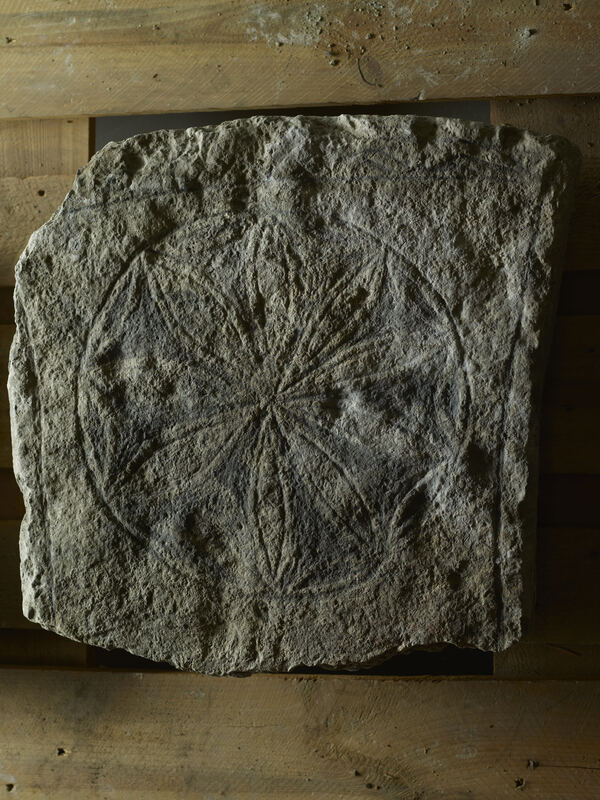
Measurements, Material and Condition The fragment represents approximately the upper half of a small picture stone of the early type. The entire head including the two slightly concave lateral edges, the slightly convex upper edge and the upper right corner is preserved. The left corner is broken off. The limestone slab is 10 cm thick, 47 cm high and 55 cm wide. The narrow sides are hewn straight and separated from the obverse by a narrow, now heavily worn chamfer. The surface is essentially flat, but quite irregular and appears weathered. The carvings, however, are well preserved and clear, except for the border on the upper edge. The carvings have been redrawn with paint.
Description of Ornament and Images A simple groove runs along the lateral edges, while the upper edge has a wide border whose decoration pattern, however, is hardly decipherable. Some wavy elements can be guessed at in the right half. Unfortunately, the area on the upper edge seems to be more weathered than the rest of the stone’s surface. The large roundel, which fills almost the entire preserved surface of the head, is clearly visible in all its details. It is decorated with a star-shaped rosette consisting of nine pointed oval leaves. Each leaf is framed.
Interpretation of the Imagery No interpretation
Type and Dating The fragment belongs to an early-type picture stone, i.e., Type A according to Lindqvist’s typology, dating between AD 400 and 600. As the monument appears to not have been much taller than circa 100 cm it must be labelled as a ʻdwarf stoneʼ. In Hauck’s typology of the Type A picture stones, the fragment from Hägvalds farm belongs to the dwarf stones of group VI, which he calls the Tofta type and which are characterised by star or rosette motifs as central motifs (1983a, p. 545).
References Lindqvist 1962, p. 17, fig. 8; Hauck 1983a, p. 545; Guber 2011, p. 153 cat. no. 88
Bildsten påträffad på gården Hägvards 1910, men den kommer troligen från det stora gravfältet Vallstenarum. Överfördes till Gotlands museum 1957.
Nuvarande lokalisering
Gotlands museums magasin i Visborgsslätt.
Beskrivning
Övre delen av en tidig bildsten (period A), bevarad längd 47 cm och bredd 55 cm. Kantdekor och en stor rundel, med rosettmönster.
Inskrift
Ingen inskrift
Datering
Kan inte dateras med säkerhet, men tillhör perioden 400-600.
Tolkning
För tolkning se GP 350 Sanda kyrka IV.
AA
 GP 350 Sanda kyrka IV
TitleGP 538 Vallstena Vallstenarum 2
Gotlands Museum ID GFC10039
Jan Peder Lamm ID 323
Last modified Apr 24, 2026