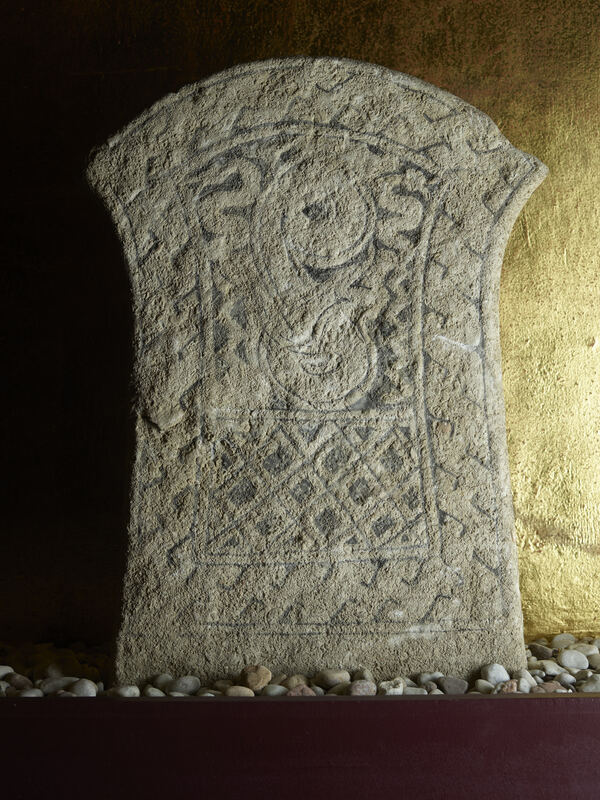
GP 340 Sanda Sandegårda I


mer grejer
0.0
| Plane | Position | Flip |

 |
||

 |
||

 |
| Show planes | Show edges |
Parish Find Location Sanda
Find Location (Lilla) Sandegårda (today Sandgårde) in Sanda parish, probably from the local Late Iron Age burial ground.
Find Context Classification Grave-field
Present Location Classification Gotlands Museum Fornsalen
Coordinate Present Location (lat) 6393355
Coordinate Present Location (long) 696536
Material Limestone
Height 104
Width 55
Thickness 11
Lindqvist Type B (ca. 500-700)
Lindqvist Shape Dwarf stone
Iconographic Keywords animal serpent geometric pattern
Runic Inscription or not No
Context and Discovery Lindqvist (1941/42 II, p. 110) only notes that picture stone no. I was found by the farmer W. Pettersson in Lilla Sandegårda, without giving a date. He mentions that stone no. II was delivered to Gotlands Fornsal in 1929 (ibid.). According to a report kept in ATA (dnr. 5102), T. J. Arne inspected stone no. I that was standing in the garden of W. Pettersson in Lilla Sandegårda in 1927. The archive also preserves a photo by Arne from 1927, which shows the stone standing upright in the garden, with the entire root anchored in the ground (ATA, run- och bildstenssamling 989:30). Arne notes that the stone was mentioned by O. V. Wennersten.
According to a letter dated 1930-01-03 which is kept in ATA, both Sanda Sandegårda I and GP 346 Sanda Sandegårda II were found on a grave field. This is probably the burial ground registered by RAÄ as Sanda 36:1 (larger part of the necropolis south of the road) and 175:1 (smaller part north of the road). Finds have been brought in from here since the middle of the 19th century. In 1936, the cemetery was mapped by G. A. Hellmann, and about 575 burials were identified. Some graves located in the north-eastern edge were investigated by Hellman in 1937. The find material, including a number of coins, comprises mainly Vendel and Viking Age objects (Thunmark-Nylén 1995–2006 IV:2, pp. 615–618, stone no. II is mentioned on p. 616 but without any further information).  GP 346 Sanda Sandegårda II
Measurements, Material and Condition “Limestone slab, up to 11 cm thick. The obverse is quite even […]. The narrow sides are 5–6 cm wide, carefully hewn flat at right angles towards the obverse, and separated from both the obverse and the reverse by a chamfer about 1 cm wide. Apart from this chamfer, the reverse is raw. The stone’s height is 104 cm, of which 75 cm are accounted for by the part above the root. The width between the upper corners is 55 cm, at the narrowest place of the body, it is 42 cm, and 46 cm at the lower edge of the decoration” (Lindqvist 1941/42 II, p. 110). The stone is completely preserved, including its root, and essentially undamaged; only the right protruding corner of the head is a bit battered.
Description of Ornament and Images “The stone is decorated with lines that in the present weathered condition lack distinct character. At least the main features of the patterns, however, can be identified nonetheless: a framing border with an inaccurately-drawn three-strand band interlace; horizontal bar; the lower panel entirely is covered with a rhombic pattern, the upper one has in its centre a broad band loop the lower, curved end of which appears to be in the shape of an animal’s head, approximately as in Salin’s Style II. On each side of this loop, the field is filled by one or more serpents” (Lindqvist 1941/42 II, p. 110). This description corresponds to the photo of the painted stone published by Lindqvist (ibid. I, fig. 48), on which all the elements mentioned can be seen exactly, including the Style II serpent and the two snakes flanking it. The latter two slither in an undulating fashion, turning their mouths outwards, while the snake in the centre forms a figure-of-eight-shape, with its head down and the tip of its tail up. Photos of the unpainted stone from 1927 and an early painted version from 1933 preserved in ATA show, however, that the images were not easy to identify (ATA, run- och bildstenssamling 989:30, 1751:10; cf. Lindqvist 1941/42 I, p. 116).
Interpretation of the Imagery Based on his extensive studies on the iconography of the Migration Period gold bracteates, Karl Hauck interpreted the depictions on Sanda Sandegårda I as an image of the supreme god Oðinn in shape of a serpent, accompanied by a pair of snakes, comparable to the motif of GP 281 När Smiss 3, on which the god flanked by two serpents is depicted in human form (1983a, pp. 535–536, 556; cf. Oehrl 2010a, pp. 439–446). Hauck understands the serpent escort as equivalent to the serpent companions of the ancient god Aesculapius. Like the Mediterranean god of healing (Küster 1913, pp. 133–137), Oðinn, according to medieval Icelandic sources, was also able to take the shape of a serpent. Snorri Sturluson gives a detailed account of Oðinn’s theft of the mead of poetry in the Skáldskaparmál (Faulkes 1998, p. 4). There Oðinn transforms himself into a snake in order to slip through a hole and get to the giantess Gunnlǫð. Furthermore, the god’s epithets Ófnir and Sváfnir, recorded as early as around AD 900 in the Skaldic Poem Haraldskvæði (stanza 11 – Finnur Jónsson 1912–1915 AI, p. 26; BI, p. 23), at the same time, according to the Edda poem Grímnismál (stanza 34 – Kuhn/Neckel 1983, p. 64), represent serpent’s names. According to Hauck (1972, pp. 59–64; 1977b, p. 507), the shape-shifting of Oðinn is also depicted on the B-bracteate of Vindum Stenhuse (IK 384). Hauck’s interpretation is appealing and based on a broad knowledge of sources and material, but ultimately remains hypothetical.
Snakes (which in the literary tradition can hardly be separated from ʻdragonsʼ or ʻwormsʼ) can have many different meanings in the Germanic-speaking cultures of Late Antiquity and the early Middle Ages (Simek 2004, pp. 144–146) which can only be outlined here. Depictions of snakes occur on 6th/7th century Frankish gravestones and Alemannic tree coffins and are therefore understood as animals of the dead, representing the souls of the deceased, as in other cultures of antiquity, including Roman religion (Böhner 2002, pp. 155–161). In the 8th century Historia Langobardorum, Paulus Diaconus tells of the Frankish king Guntram sending out a snake from his mouth in a dream (Waitz 1878, pp. 138–140). The snake – apparently a kind of alter ego or representation of the soul – had come across a treasure on its dream journey, which Guntram recovered after his awakening. Figurative representations of serpents that drive out of the mouths of human figures can occasionally be found in Germanic and Viking art (Böhner 1987, p. 469, fig. 21:2; Oehrl 2010a, pp. 444–446, fig. 26, pl. VI:1).
Since Antiquity, snakes were considered particularly wise and were often associated with the acquisition of supernatural knowledge and mantic abilities (e.g., Küster 1913, pp. 121–137; Egli 1982, pp. 137–139; Oehrl 2010). In the Gospel of Matthew (10, 16) it is stated: estote ergo prudentes sicut serpentes. The idea that eating snakes or snake saliva confers knowledge of animal language and prophetic knowledge is widespread, not only recorded in several ancient myths and, for example, Pliny’s Naturalis historia (liber X:LXX and XXIX:XXII – König 1986, p. 96; 1991, p. 60), but also in the Gesta Danorum of Saxo Grammaticus (liber V:129–130 – Friis-Jensen/Fisher 2015; Herrmann 1901, p. 172–173). There are also traces of snake worship among the Germanic tribes. Reference must be made to the 7th-century snake idol mentioned in the Vita Barbati (Waitz 1878, pp. 557, 562), which is said to have been worshipped by the Langobards and could be regarded as an image of Wodan (De Vries 1956–1957 I, p. 362; II, p. 64).
However, in the interweavings of the Germanic animal style, snake creatures seem to have been conceived as demonic beings that were captured and rendered harmless through knotting and interweaving and thus used as apotropaion. In the middle of the 8th century, St. Boniface described Germanic (Saxon) animal ornament as an expression of pagan superstition and the work of the devil (Høilund Nielsen 2002: 8–10). The demon-banishing power of knots and interlace is well-documented in both Antiquity and the Middle Ages (Weigert 1938; Wamers 2008: 52–54). In this sense, the snake-like creatures of the Germanic animal styles represent ominous powers that are trapped and rendered harmless by knotting and interlacing. In the iconography of Vendel Period helmet plates, snakes appear as demonic enemies of human warriors, as they do on the Gotlandic Type A picture stones (see GP 268 Martebo kyrka I, cf. GP 173 Hangvar Austers I and GP 350 Sanda kyrka IV). Probably the best-known serpent-shaped demon in Old Norse tradition is the Midgard Serpent (miðgarðsormr), along with two other prominent monsters, of which it is not entirely clear whether they are to be understood as snakes or dragons – the dragon Fáfnir is said to lie í orms líki (ʻin shape of a snake/wormʼ) on the Gnitaheiðr (Reginsmál, prose after stanza 14 – Neckel/Kuhn 1983, p. 176), and the terms naðr (ʻadder/snakeʼ) and dreki (ʻdragonʼ) are used for the same demon Níðhöggr in Vǫluspá stanza 66 (ibid. p. 15).
The possibilities of interpreting serpent images such as the one from Sandegårda are, as could only be hinted at here, extremely diverse. Finally, there is another possible interpretation, which is particularly appealing because it refers to the origin myth of the Gotlanders passed down in the Guta saga (ch. 1 – Peel 1999, p. 3): The Gutnic people’s ancestress Huitastierna dreams, before she gives birth to her three sons who are later to rule the three parts of Gotland, that she carries three intertwined snakes in her womb. Possibly the three serpents on the picture stone represent the three progenitors of Gotland? A woman with spread legs (childbearing posture?) and snakes in her hands can be seen on the stone GP 281 När Smiss 3 and has therefore also been associated with this very myth.  GP 281 När Smiss 3
 GP 268 Martebo kyrka I
 GP 173 Hangvar Austers I
 GP 350 Sanda kyrka IV
Type and Dating Middle-type picture stone, which means a Type B ʻdwarf stoneʼ, dating to between AD 500 and 700. The monument belongs to the group of Type B stones featuring a convex head with pronounced corners protruding horizontally. The snake head typical of Style II, which in similar form also appears in the border decoration of GP 368 Stenkyrka kyrka IX, points to the period between the late 6th century and about AD 700. According to Lindqvist (1941/42 I, pp. 116–117), the best parallels can be found in jewelry dating to the very late 7th century, while Nylén, based on Gotlandic grave finds, concludes “around 600 or slightly later” (Lamm/Nylén 2003, p. 46). In any case, these animal style ornamented stones are of particular importance for the dating of Type B. According to Martin Rundkvist’s (2012, p. 160) typology, the stone’s shape represents Type dwarf2, belonging to his period 2, which he dates to the Early Vendel Period.
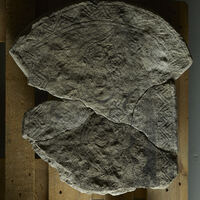
Remotely serpent-like interlace motifs comparable to the image on the stone from Sandegårda can be observed on the Type B stones GP 156 Halla Broa XI and GP 335 Rute Ala. Due to their similar shape and ornamentation, Lindqvist (1941/42 I, p. 37–38) assigns them to his Alagruppe, named after Rute Ala. According to Larsen (2009, pp. 32, 35–36), who investigated both stones by 3D scanning, their serpent-like ornaments are typical for the 7th-century animal style. In his opinion, they originate from one and the same stone carver. At Lindqvistʼs time, these two monuments were the only known picture stones decorated in this way. A third specimen, however, is represented by the recent find from GP 297 Unknown find spot. Although the Sandegårda stone obviously belongs to this group in terms of motif, Lindqvist considers it typical of the Sandegårdagruppe named after it (1941/42 I, p. 37).  GP 368 Stenkyrka kyrka IX
 GP 156 Halla Broa XI
 GP 335 Rute Ala
 GP 297 Unknown Find Spot
References Lindqvist 1941/42 I, pp. 37, 89, 116, fig. 48; II, p. 110; Hauck 1983a, pp. 535, 556, fig. 38; Lamm/Nylén 2003, pp. 46–47; Oehrl 2010a, p. 448; 2019a, p. 11, fig. 2c; Guber 2011, pp. 68, 141 cat. no. 64.
Bildsten påträffad av bonden på Lilla Sandegårda, troligen på det närbelägna gravfältet. Stenen stod 1927 i gårdens trädgård och överfördes till Gotland museum 1929.
Nuvarande lokalisering
Utställd i Bildstenshallen på Gotlands museum.
Beskrivning
Dvärgsten (period B), 104 cm hög och som bredast 55 cm. Bildstenen har två bildfält, det nedre täckt av ett rombiskt mönster, det övre en knut med avslutning med ett djurhuvud.
Inskrift
Ingen inskrift
Datering
Kan inte dateras med säkerhet, men tillhör perioden cirka 500-700.
Tolkning
Flera alternativ har presenterats, men tolkningen är svår att avgöra.
AA
TitleGP 340 Sanda Sandegårda I
Gotlands Museum ID GFC6347
Jan Peder Lamm ID 216
Lindqvist Title Sanda, Sandegårda I
Last modified Apr 23, 2026