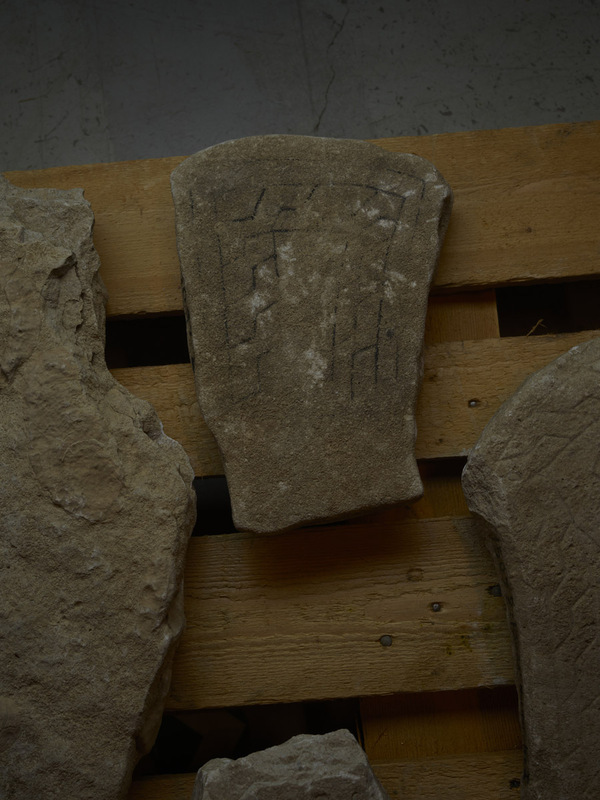
GP 250 Lärbro Norder-Ire II


mer grejer
0.0
| Plane | Position | Flip |

 |
||

 |
||

 |
| Show planes | Show edges |
Parish Find Location Lärbro
Find Location At the outer edge of a mound belonging to the property of Norder-Ire gård, Lärbro parish.
Find Context Classification Private Property
Present Location Classification SHM Storage
Coordinate Present Location (lat) 6581391
Coordinate Present Location (long) 675775
Material Limestone
Height 32
Width 23
Thickness 5
Lindqvist Type A (ca. 400-600)B (ca. 500-700)
Lindqvist Shape Dwarf stone
Runic Inscription or not No
Context and Discovery The only brief reports about the find are given by Oscar Wennersten in the newspaper Gotlands Allehanda, Christmas issue 1913, and in the catalogue of Statens Historiska Museum in Stockholm (dnr 412/763-1913). Lindqvist (1941/42 II, p. 89) notes that GP 249 Norder-Ire I “was found in the summer of 1913 during foundation works for a small house at the outer edge of a mound in a former meadow. After the find was reported by the farmer Karl Andersson, the find place was examined by Wennersten, who subsequently in the autumn of the same year discovered the other stones (GP 250 Norder-Ire II, GP 251 Norder-Ire III, GP 265 Norder-Ire IV, and GP 266 Norder-Ire [V]) during his investigations along the side of the building where No. I had come to light. Whether the mound was of natural or artificial origin could not be determined.” The place where the stones were found was called ʻNorder-Ire Torgʼ by the local population. Eight further small fragments of an apparently worked limestone slab, which were uncovered during Wennersten’s investigation as well, were interpreted by Jan Peder Lamm (Lamm/Nylén 2003, p. 190) as a fifth picture stone (GP 266 Norder-Ire [V]). Furthermore, two fragments of a grinding stone were discovered together with the picture stones.  GP 249 Lärbro Norder-Ire I
 GP 251 Lärbro Norder-Ire III
 GP 265 Lärbro Norder-Ire IVGP 266 Lärbro Norder-Ire (V)
Measurements, Material and Condition “Limestone slab, 5 cm thick. The obverse is smooth, the narrow sides are reasonably at right angles towards the obverse, but they are not even. Presumably, they are hardly worked at all, but formed by nature. The reverse is rough and unworked. This stone is the smallest of all known picture stones. Its height is 32.5 m, of which about 24 cm are accounted for by the part above the base. The width between the upper corners is 23 cm” (Lindqvist 1941/42 II, p. 89). The tiny monument is completely preserved, including the root. There is no serious damage and not much weathering and abrasion. The material, however, looks perforated and grainy.
Description of Ornament and Images Lindqvist, who provides a photo of the painted stone, describes the decoration as follows: (1941/42 I, fig. 46 [cf. ATA B3:60, 1937]; II, p. 89): “The stone is decorated with shallowly carved, 1–3 mm wide lines forming a framing border with a simplified band pattern.” The border with the geometricised twisted cord pattern fills almost the entire surface; there is only a narrow vertical field left open in the middle, which remains undecorated. Photos of the unpainted stone from 1933 (1750:65b; 977:11e), a drawing by O. Sörling from 1918, and drawings (rubbings) on tracing paper are kept in ATA (Run- och bildstenssamling).
Interpretation of the Imagery No interpretation
Type and Dating Due to its typical border decoration, Lindqvist assigns the tiny picture stone to his ʻAbschnittʼ B, dating between AD 500 and 700. The special monument, which represents the smallest of all known Gotlandic picture stones, does not belong to any of Lindqvist’s subgroups. There is no comparable monument known so far. The stone’s shape, however, roughly rectangular, widening towards its slightly convex upper edge, almost axe-shaped, is unusual for a Type B monument and looks more like a Type A stone (cf. Larsen 2009, p. 33). Therefore, in Rundkvist’s typology (2012, p. 160) Lärbro Norder-Ire II belongs to group dwarf1, dating to the Migration Period.
References Lindqvist 1941/42 I, p. 38, fig. 46; II, p. 89; Larsen 2009, pp. 33–34, fig. 30; Oehrl 2019a, p. 67.
Bildstenen påträffades 1913 vid efterundersökning av husbygge i kanten av en hög i ett tidigare änge tillhörande gården Norder Ire. Vid undersökningen påträffades GP 249, 251, 265 och 266 Lärbro Norder-Ire I, III-V vid samma hög.
Nuvarande lokalisering
Statens Historiska Museum, magasinet i Tumba
Beskrivning
Helt bevarad liten bildsten (period B), 32,5 cm hög och största bredd 24 cm. Kantdekor fyller största delen av stenen. Innanför denna dekor ingen bild.
Datering
Kan inte dateras med säkerhet, tillhör perioden 500-600-talen.
Tolkning
Ingen tolkning.
AA
GP 249 Lärbro Norder-Ire IGP 251 Lärbro Norder-Ire IIIGP 265 Lärbro Norder-Ire IVGP 266 Lärbro Norder-Ire (V)
TitleGP 250 Lärbro Norder-Ire II
Jan Peder Lamm ID 178
Statens Historiska Museer ID 15099:2
Lindqvist Title Lärbro, Norder-Ire II
Last modified Apr 23, 2026