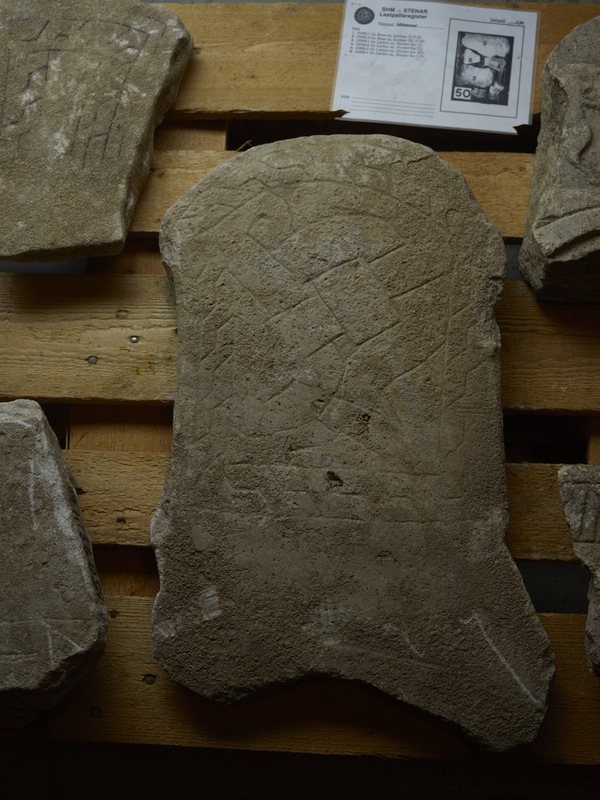
GP 249 Lärbro Norder-Ire I


mer grejer
0.0
| Plane | Position | Flip |

 |
||

 |
||

 |
| Show planes | Show edges |
Parish Find Location Lärbro
Find Location At the outer edge of a mound belonging to the property of Norder-Ire gård, Lärbro parish.
Find Context Classification Private Property
Present Location Classification SHM Storage
Coordinate Present Location (lat) 6581391
Coordinate Present Location (long) 675775
Iconographic Keywords interlace
Runic Inscription or not No
Context and Discovery The only brief reports about the find are given by Oscar Wennersten in the newspaper Gotlands Allehanda, Christmas issue 1913, and in the catalogue of Statens Historiska Museum in Stockholm (dnr 412/763-1913). Lindqvist (1941/42 II, p. 89) notes that Norder-Ire I “was found in the summer of 1913 during foundation works for a small house at the outer edge of a mound in a former meadow. After the find was reported by the farmer Karl Andersson, the find place was examined by Wennersten, who subsequently in the autumn of the same year discovered the other stones (GP 250 Norder-Ire II, GP 251 Norder-Ire III, GP 265 Norder-Ire IV, and GP 266 Norder-Ire [V]) during his investigations along the side of the building where No. I had come to light. Whether the mound was of natural or artificial origin could not be determined.” The place where the stones were found was called ʻNorder-Ire Torgʼ by the local population. Eight further small fragments of an apparently worked limestone slab, which have been uncovered during Wennersten’s investigation as well, were interpreted by Jan Peder Lamm (Lamm/Nylén 2003, p. 190) as a fifth picture stone (GP 266 Norder-Ire [V]). Furthermore, two fragments of a grinding stone were discovered together with the picture stones.  GP 250 Lärbro Norder-Ire II
 GP 251 Lärbro Norder-Ire III
 GP 265 Lärbro Norder-Ire IVGP 266 Lärbro Norder-Ire (V)
Measurements, Material and Condition “Limestone slab, up to 6.5 cm thick. The obverse is naturally even, parts of the polished surface survived unweathered. The narrow sides are hewn at right angles towards the obverse, with a chamfer of 1 cm width in between. The reverse is rough and unworked. The height is 61 cm, or 39 cm when measured from the lower edge of the decoration. At its narrowest part, the body is 31 cm wide, at the corners 33 cm” (Lindqvist 1941/42 II, p. 89). The small monument is completely preserved, including its massive root. The right edge and corner of the head, however, are a little bit damaged. Also, a very small part of the left corner is chipped. Some parts of the surface appear to be worn; however, it is largely in good condition and the decoration well discernible.
Description of Ornament and Images Lindqvist provides a photo of the painted stone and describes it (1941/42 I, fig. 36; II, p. 89): “Decorated with about 2 mm wide and 1 mm deep carved lines and chiseled background fields. Inside of the framing border with its simplified ‘twisted-cord’ pattern, most of the panel is filled by interlace formed by a ribbon. One of its ends is visible in the top left corner, while the other, rather unclear end either is in the middle of the panel’s lower edge or possibly close to the bottom left corner.” The rounded end of the ribbon in the top left corner is a bit curling – clear zoomorphic features indicating a serpent or serpent-like animal (Larsen 2009, p. 33), however, are missing. A drawing by O. Sörling from 1914 and a drawing on tracing paper kept in ATA do not provide further information.
Interpretation of the Imagery If the interlace and knot motifs on Norder-Ire I and other middle type ʻdwarf stonesʼ such as GP 193 Hellvi Ire III and GP 74 Endre skog represent more than just decoration, an apotropaic intention should be taken into consideration. The conception of knot, net and interlace patterns as magical protective devices against all kinds of harm, fettering, capturing and caging the evil in their impenetrable web, is widespread and well documented in Antiquity and the Middle Ages, and has also been discussed regarding Late Iron Age Scandinavia, namely in case of the animal style (e.g. Scheftelowitz 1912; Weigert 1938; Wessel 1971; Zischka 1977; Kitzinger 1993; Graf 2010, 29–35; Wamers 2008, 52–54; Oehrl 2011a, pp. 265–288; Oehrl 2019a, p. 123) – That serpent-like animals, intertwined and knotted together, represent fettered and defanged demons, is easy to imagine. In the case of the Gotlandic picture stones, the possible apotropaic power of interlace and knot motifs (possibly also of ʻnetʼ patterns depicted on GP 92 Gammelgarn Rommunds; GP 354 Sjonhem Lilla Sojvide; GP 340 Sanda Sandegårda I; GP 273 Norrlanda Bjärs; GP 578 Alva Änge; GP 193 Hellvi Ire III?) would most probably be directed against grave robbers or against the buried person, whose return was feared. Measures against both are well proven, e.g., by runestone inscriptions (Düwel 1978).  GP 193 Hellvi Ire III
 GP 74 Endre skogGP 92 Gammelgarn Rommunds
 GP 354 Sjonhem Lilla Sojvide
 GP 340 Sanda Sandegårda IGP 273 Norrlanda Bjärs
 GP 578 Alva änge
Type and Dating Middle-type picture stone, i.e., Type B according to Lindqvist, dating to between AD 500 and 700. The stone belongs to those Type B stones described by Lindqvist (1941/42 I, pp. 38–39) as ʻdwarf stonesʼ with convex head and corners protruding horizontally. Lindqvist’s classification of the stone is more than confusing. In the description of his Type B subgroups, he assigns it to the Sojvidegruppe (ibid. pp. 36–37) but later in his overview table he notes it under Stenstugruppe (ibid. p. 38). Neither assignment is convincing since interlace motifs are the main characteristic of Lindqvist’s Alagruppe (ibid. p. 37). Lindqvist compares the interlace pattern of Norder-Ire I and other middle type picture stones with the decoration of Vendel Period brooches to support his dating of ʻAbschnittʼ B (ibid. p. 116). In Rundkvist’s typology (2012, p. 160), the stone belongs to group dwarf2, dating to the early Vendel Period.
References Lindqvist 1941/42 I, pp. 36–37, 116, fig. 36; II, p. 89; Varenius 1992, p. 58, fig. 5a; Larsen 2009, p. 33, fig. 29; Guber 2011, p. 135 cat. no. 51; Oehrl 2019a, p. 67.
Bildstenen påträffades 1913 vid husbygge i kanten av en hög i ett tidigare änge tillhörande gården Norder Ire. Vid efterundersökning påträffades GP 250, 251, 265 och 266 Lärbro Norder-Ire II-V vid samma hög.
Nuvarande lokalisering
Statens Historiska Museum, magasinet i Tumba
Beskrivning
Helt bevarad liten bildsten (period B), 61 cm hög och största bredd 33 cm. Kantdekor och innanför denna ett flätmönster och möjligen en orm.
Datering
Kan inte dateras med säkerhet, tillhör perioden 500-600-talen.
Tolkning
Flätmönstret kan vara en ontavvärjande symbol.
AA
GP 250 Lärbro Norder-Ire IIGP 251 Lärbro Norder-Ire IIIGP 265 Lärbro Norder-Ire IVGP 266 Lärbro Norder-Ire (V)
TitleGP 249 Lärbro Norder-Ire I
Jan Peder Lamm ID 177
Statens Historiska Museer ID 15099:1
Lindqvist Title Lärbro, Norder-Ire I
Last modified Apr 23, 2026