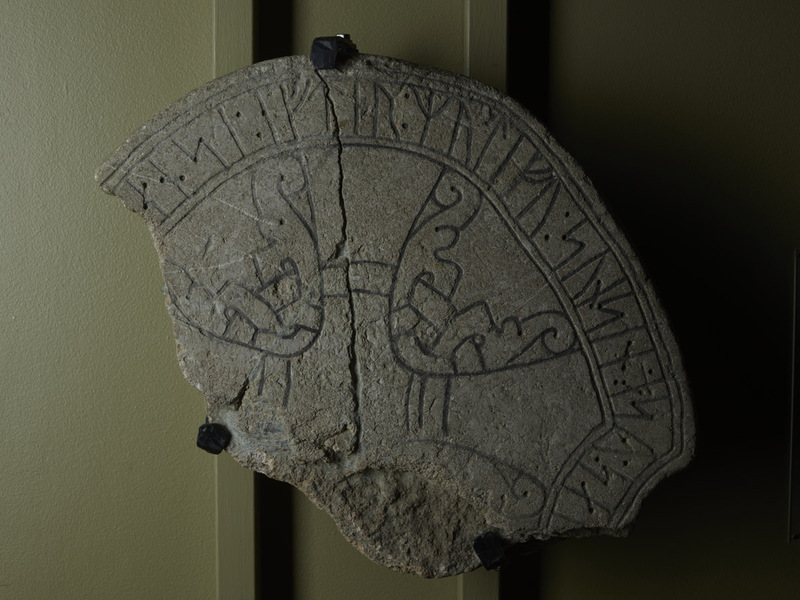
GP 214 Kräklingbo Smiss II


mer grejer
0.0
| Plane | Position | Flip |

 |
||

 |
||

 |
| Show planes | Show edges |
Parish Find Location Kräklingbo
Find Location In Smiss, found in a trench during roadbuilding.
Find Context Classification Other
Present Location Classification Gotlands Museum Fornsalen
Coordinate Present Location (lat) 6393355
Coordinate Present Location (long) 696536
Material Limestone
Height 45
Width 54
Thickness 10
Lindqvist Type E (ca. 1000-1150)
Lindqvist Shape Dwarf stone
Runic Inscription or not Yes
Runic Inscription … …ansi : eftir : mutifu : sun sin : asy : sa-…
Old West Norse
… [þ]enna eptir <mutifu>, son sinn … …
Runic Swedish
… [þ]annsi æftiʀ <mutifu>, sun sinn … …
English
… this in memory of <mutifu>, his son …
Swedish
… denna [sten] efter <mutifu>, sin son …
Quote from Runor
Context and Discovery Two matching fragments that were found in 1912 by the farmer Karl Gardell when he dug a trench for the construction of a path. They were donated to Gotlands Museum by Lektor M. Klintberg.
So far, five picture stones are known from the parish (GP 214–218). Near Smiss, there is also a large grave field.
LKÅ GP 215 Kräklingbo Smiss IV
 GP 216 Kräklingbo Smiss IGP 217 Kräklingbo Smiss III
 GP 218 Kräklingbo kyrka
Measurements, Material and Condition Limestone slab, up to 10 cm thick. The width of the preserved piece is 0.54 m (the width of the complete head was about 0.60 m), its height 0.45 m. It is a part of a head of a picture stone, with the left side broken off. The fragment was broken into two parts, but it was mended.
“The obverse hewn flat and polished. The narrow sides are dressed at approximately right angles towards the obverse, but slightly convex. The reverse is rough and unworked. Decoration with 3-mm-wide, distinct lines with rounded bases. For the pattern and the inscription, a drill of about 4 mm diameter often was used. Fine sketch lines that were scratched with a sharp instrument before they unalterably were chiselled in still are recognizable at some places, particularly next to the 4th and 5th runes at the end of the surviving inscription. In contrast, certain lines that damaged the runic inscription and probably are secondary, were carved more powerfully, but not purposefully levelled or smoothed, e.g., the horizontal line running parallel to the border close to the 7th rune from the back” (Lindqvist 1941/42 II, p. 82). In a 1936 photo by Alfred Edle, it can be seen that the carving was filled in with white chalk. In 1954, another photo by Iwar Andersson shows the stone filled in with black paint (Run- och bildstenssamlingen ATA).
LKÅ
Description of Ornament and Images Runic inscription along the edge with double incised contour lines. Inside of the border, there is a ringed cross with vegetative ornament between its cross-arms. There are drilled separation marks and some of the branches of the runes have drilled endpoints, which is a typical characteristic of Gotland runestones (see GP 362 Stenkumla kyrka II).
LKÅ GP 362 Stenkumla kyrka II
Interpretation of the Imagery Other runic picture stones with crosses include GP 588 Atlingbo kyrka (G 200), GP 235 Linde kyrka, GP 208 Hogrän kyrka (G 203), GP 355–356 Sjonhem kyrka(G 134–135), GP 362 Stenkumla kyrka (G 208) and GP 130 Hablingbo kyrka (G 370). The last-mentioned stone from Hablingbo is perhaps the best parallel regarding the size of the cross, with its cross-arms filling the available space and the shaft continuing below the neck of the stone. Thorgunn Snædal includes the stone in her group of picture stone-shaped runestones with Middle Scandinavian runestone ornament (Snædal 2002, p. 67).
Cecilia Ljung discussed the small runic picture stones of type E in relation to early Christian grave monuments on Öland (see also GP 279 När Mickelgårds). They have in common their small size, dressed shape, and that the ornament often is carved in relief. It is reasonable to believe that the Gotland stones had the same function as grave monuments as the Öland stones, but as Ljung observes, not all on Gotland have been found in churchyards (Ljung 2016 I, p. 165f.). Just as for example GP 279 När Mickelgårds and GP 217 Kräklingbo Smiss III (G 117), our stone GP 214 (G 116) has been found more than a kilometre from the church.
LKÅ GP 588 Atlingbo kyrka
 GP 235 Linde kyrka
 GP0208
 GP 355 Sjonhem kyrka I
 GP 356 Sjonhem kyrka IIGP 362 Stenkumla kyrka II
 GP 130 Hablingbo kyrka 2
 GP 279 När MickelgårdsGP 217 Kräklingbo Smiss III
Runic Context and Comments The inscription includes an unusual name, which for long escaped interpretation in relation to the Old Norse name “treasure”. The name of the commemorated son in the inscription is represented by the runic sequence mutifu. Snædal suggests that the son might have been named after someone the father met in his travels to foreign countries (Snædal 2004, p. 36). Another suggestion is that mutifu can be interpreted as accusative of Mutt-Ifa (Jacobsson 2004, p. 122f.), but this interpretation has been met with some skepticism, partly because the supposed main name is unusual or unknown (Källström 2012, p. 69).
LKÅ
Type and Dating Type E, dwarf stone. 11th century.
LKÅ
References Lindqvist 1941/42 II, p. 82, Fig. 430, GR I, G 116; Snædal 2002, pp. 67, 74; 2004, p. 36.
TitleGP 214 Kräklingbo Smiss II
Gotlands Museum ID GFC1875
Jan Peder Lamm ID 158
Lindqvist Title Kräklingbi, Smiss II
Runverket ID G 116
Last modified Apr 23, 2026