GP 176 Hangvar kyrka 4


mer grejer
0.0
| Plane | Position | Flip |

 |
||

 |
||

 |
| Show planes | Show edges |
Parish Find Location Hangvar
Find Location Hangvar church
Find Context Classification Church
Coordinate Find Location (lat) 6416789
Coordinate Find Location (long) 718928
Parish Present Location Hangvar
Present Location In situ, re-used as step in front of the altar.
Present Location Classification ChurchIn-Loco
Coordinate Present Location (lat) 6416789
Coordinate Present Location (long) 718928
Material Limestone
Height 159
Width 70
Thickness 8
Lindqvist Type C/D (ca. 700-1000)Unclear (ca. 400-1150)
Lindqvist Shape Tall stoneUnclear
Runic Inscription or not No
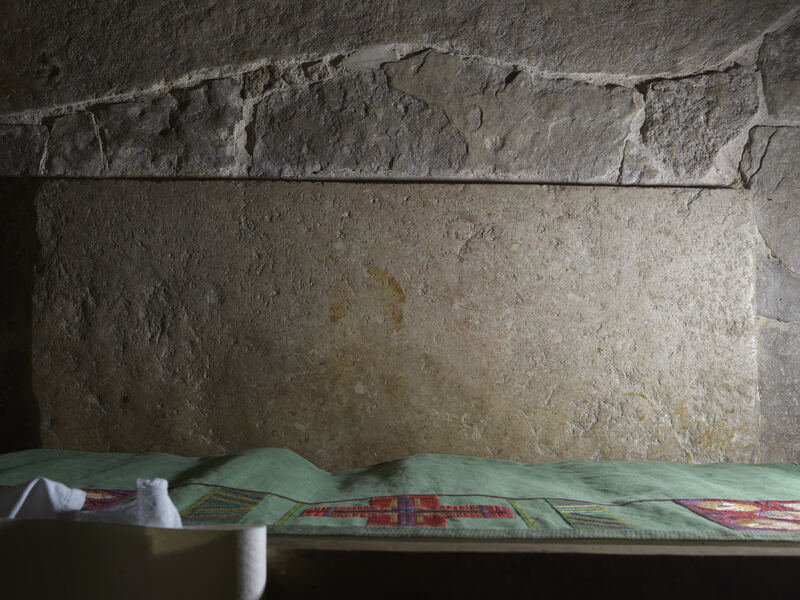
Context and Discovery The rectangular limestone slab is placed in front of the altar, re-used as a step. It was discovered and considered a picture stone by Beata Böttger-Niedenzu in 1983. During the years 1981 to 1985, Böttger-Niedenzu from the Ludwig Maximilians University in Munich surveyed the Gotlandic rural churches, discovering not fewer than 38 previously unknown picture stones, which she published in a brief catalogue in 1988. In front of the stone, the large Type C/D picture stone GP 171 Hangvar kyrka III is built into the floor of the choir. The Type C/D monument GP 175 Hangvar kyrka II had been embedded into the floor of the choir as well, next to the altar, but is now kept in Gotland’s Museum.
The entire church is Romanesque and was constructed around the middle of the 13th century. The choir represents the oldest part of the building, the nave was erected shortly afterwards, and finally the tower.  GP0171
 GP 175 Hangvar kyrka II
Measurements, Material and Condition The step stone represents an accurately worked flat cuboid shape with a length of 1.59, a width of 0.66, and a thickness of 0.08 m. The color of the limestone is a dark and slightly reddish grey, and no notable fossil inclusions are visible. The middle part of the surface next to the altar is completely abraded as this is the part of the step where the priest stands when celebrating the liturgy. Only the edge areas of the surface in the north, south and west show some remains of the original surface.
Description of Ornament and Images In the edge areas of the slab, which to some extent preserve the original surface, some deep structures with a rough surface are discernable. These structures could represent the background plane of an almost completely lost bas-relief. According to Böttger-Niedenzu (1988, p. 11), these possible remnants of carvings could indicate an interlace border. The relevant structures are best visible on the right (i.e., southern) edge of the step. With appropriate lighting, parts of ribbons are visible.
Interpretation of the Imagery No interpretation
Type and Dating Possible remnants of a bas-relief and the stone’s size might indicate a Type C/D picture stone dating between the 8th and the 10th century. Type E is less probable since tall E-stones are usually carved with deep and distinct inscriptions and rune stone ornament which do not disappear completely just by weathering or abrasion. However, it remains uncertain whether this slab represents a picture stone fragment or not. Taking into consideration the fact that two more Type C/D monuments were built into the floor next to the altar, this assumption seems not unlikely.
References Böttger-Niedenzu 1988, p. 11.
Stenen påträffades i Hangvar kyrka år 1983. Den utgör steget precis framför altaret.
Nuvarande förvaringsplats
Stenen ligger fortfarande framför altaret.
Beskrivning
Steget är rektangulär, 1.59 m lång och 0.66 cm bred. Ytan har nötts ned av prästens fötter.
Det finns bara några smärre huggspår som möjligtvis utgör resterna av en utmejslad lågrelief. Kanske handlar det om en sekundärt omhuggen bildsten.
Datering
700-talet eller mellan omkring år 800 och 900-talet e.Kr. (vikingatid), om det verkligen handlar om en bildsten.
Tolkning
Ingen tolkning.
SO
TitleGP 176 Hangvar kyrka 4
RAÄ ID 122
Jan Peder Lamm ID 411
Last modified Apr 23, 2026