GP 172 Hangvar Austers II


mer grejer
0.0
| Plane | Position | Flip |

 |
||

 |
||

 |
| Show planes | Show edges |
Parish Find Location Hangvar
Find Location On the property of the farm ʻAusters gårdʼ in Hangvar parish, next to an old road.
Find Context Classification Private Property
Present Location Classification Gotlands Museum Magasin Visborg
Coordinate Present Location (lat) 6390259
Coordinate Present Location (long) 695514
Material Limestone
Limestone Type Fine reef debris limestone
Geological Group Hangvar Formation (70%)
Height 68
Width 78
Thickness 12,5
Lindqvist Type C/D (ca. 700-1000)E (ca. 1000-1150)
Lindqvist Shape Tall stone
Runic Inscription or not No
Context and Discovery Lindqvist (1951/42, p. 69) gives the following information about the find circumstances: “Upper part of a picture stone, found in 1913, about 250 m west to the main road Austers—Tingstäde and about 100 m south of the road Austers—Ireviken, by the side of an older path. In 1933, the stone was brought to the farmstead of Mr. A. Andersson, where it was located in 1940. Inventory and information are by M. Stenberger.”
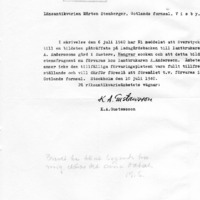
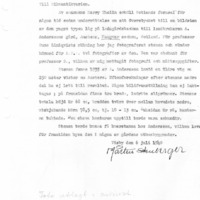
In 1940, Gotlands Fornsal was informed that the picture stone was kept at the farmstead, and in 1942 it was moved to the museum in Visby (dnr 1910/40; 3397/42). Differing from Lindqvist’s remarks, County Antiquarian Mårten Stenberger wrote in his letter to the National Antiquarian in Stockholm (1940-06-06; dnr 1910/40) that the stone had been found in 1933. Likewise, the newspaper Gotlands Allehanda reported on the stone in the 26 April 1933 issue and presented it as recent find.
The National Heritage Board’s number of the find spot, RAÄ Hangvar 12:1, does not indicate the original find location but the place at the farmstead, where the stone was placed in 1940.
Measurements, Material and Condition The fragment represents almost the entire head of a large mushroom-shaped picture stone, including its typical corners. Only a small part of the upper left edge seems to be broken off. The neck is partly preserved as well. The monument’s surface is covered by three vertical grinding grooves. The limestone slab’s maximum height (along the right grinding groove) is 68 cm, its width between the corners 78.5 cm. The thickness is about 12 cm.
Description of Ornament and Images No traces of decorations remain.
Interpretation of the Imagery No interpretation
Type and Dating The shape of the picture stone head clearly indicates a Type C/D or E monument. Thus, the stone can be roughly dated to between the 8th century (or about 800) and around AD 1100.
The grinding grooves cannot be used for dating picture stones, as they represent secondary features, produced after the creation of the stone, and in all probability after the period when the slab was used as memorial stone and raised in the landscape. Arne Philip (1986, pp. 9–12) counted 15 Gotlandic picture stones with grinding grooves (slipskåror or sliprännor). There is at least one more, GP 72 Endre Bäcks [C], which is almost completely covered by 15 deep grooves. On Gotland, those grinding grooves on stones and rocks are extremely common and have been interpreted in various ways (Munthe 1933; Mårtensson 1936; Swanström 1995; Gibson 2013). Their frequent interpretation as prehistoric calendars (Henriksson 1983) is not compelling, cf. the critical views of Lindström (1997). Similar grooves can be encountered in many places throughout Europe. An unwieldy abundance of literature has been published about their dating and their function (gathered and summarised by Eitelmann 2005, pp. 189–194 and Schels, 2010, pp. 141–161). Especially when found on medieval and early modern church buildings, gravestones and conciliation crosses, those grooves and cups could be the result of grinding to make stone meal, presumably for use in religious folk medicine. Probably, the medieval Gotlanders regarded the picture stones as efficacious relics and powerful media of ancient times and therefore used them for folk religious purposes (Oehrl 2019a, pp. 41, 105–106; Oehrl 2020a, pp. 88–89).  GP0072
References Lindqvist 1941/42 II, p. 69, fig. 407; Philip 1986 pp. 11–12, bild 7.
Bildstenen påträffades 1913 (eller 1933) vid en gammal gångstig, cirka 250 m väster om vägen Austers-Tingstäde och cirka 100 m söder om vägen Austers-Ireviken. Stenen fördes 1933 till gården Austers och 1942 till Gotlands fornsal i Visby.
Nuvarande lokalisering
Gotlands Museums magasin, Visborgslätt
Beskrivning
Den övre delen av en stor svampformad bildsten (typ C-D). Bredden mellan hörnen är 78.5 cm. Bildytan är förstörd av tre stora sliprännor.
Datering
Dateringen kan inte anges närmare, men bildstenen tillhör perioden 700-1000-talen.
Tolkning
Ingen tolkning.
AA
TitleGP 172 Hangvar Austers II
RAÄ ID Hangvar 12:1
Gotlands Museum ID GFC11027
Jan Peder Lamm ID 127
Lindqvist Title Hangvar, Austers II
Last modified Apr 23, 2026