GP 95 Garda kyrka 7


mer grejer
0.0
| Plane | Position | Flip |

 |
||

 |
||

 |
| Show planes | Show edges |
Parish Find Location Garda
Find Location Garda churchyard
Find Context Classification Churchyard
Coordinate Find Location (lat) 6358371
Coordinate Find Location (long) 715673
Parish Present Location Garda
Present Location In situ, embedded into the northern lychgate at Garda.
Present Location Classification ChurchyardIn-Loco
Coordinate Present Location (lat) 6358371
Coordinate Present Location (long) 715673
Year of Discovery 1984
Iconographic Keywords ship waves sail human figure polygon
Runic Inscription or not No
Context and Discovery The fragment inside the lychgate was discovered by Beata Böttger-Niedenzu in 1984. In 1982, Böttger-Niedenzu submitted her master’s thesis on Gotland’s picture stones to the Ludwig-Maximilians-University of Munich, and during the years 1981 to 1985, she visited the Gotlandic rural churches, discovering not fewer than 38 previously unknown picture stones, which she published in a brief catalogue in 1988.
The picture stone fragments GP 97 Garda kyrka I and GP 98 Garda kyrka II, which are incorporated into the tower, first recorded in 1914, were published by Sune Lindqvist in 1941/42; four more picture stone fragments GP 99–102 Garda kyrka 3–6 were discovered under the floor of the nave by Gustav Trotzig during archaeological excavations in 1968 (Trotzig 1970). These fragments had been re-used in the floor of an earlier church building. Garda church is regarded as one of the oldest churches of Gotland (Lagerlöf 1972; Lagerlöf/Svahnström 1991, pp. 142–144; Andrén 2011, pp. 199–201). As early as around AD 1100, there was a wooden church at the same place. This Viking Age church wassplaed by an early Romanesque building by the middle of the 12th century, the nave and the lower part of the tower of which are still preserved. In the middle of the 13th century, the tower was built up to its present height; in the first half of the 14th century, the Romanesque choir and apse were demolished and replaced by the current large Gothic choir. Among the church’s most remarkable features are the Russo-Byzantine wall paintings on the tower arch and in the nave.
The stone found by Böttger-Niedenzu in 1984 was wrongly labelled by Jan Peder Lamm as “Garda kyrka 4” (Lamm/Nylén 2003, p. 202). As a matter of fact, GP 101 Garda kyrka 4 is one of the four stones discovered by Trotzig in 1968. Therefore, the stone in the lychgate must be labelled as Garda kyrka 7 instead. The rectangular stone was incorporated into the niche in the inner wall of the northern lychgate, representing the bottom slab of the niche. The churchyard’s southern, eastern and northern lychgates originate from the period 1350–1375. The western lychgate was built between 1200 and 1250.  GP 97 Garda kyrka I
 GP 98 Garda kyrka II
 GP 99 Garda kyrka 3
 GP0100
 GP0101GP0102
Measurements, Material and Condition The rectangular stone slab, which forms the bottom plate of the western niche, is 1.62 m long and 0.38 m wide. The surface of the limestone slab is relatively rough and much weathered. Its color is dark grey, even black in many places. The most northern quarter of the rectangular fragment is brighter in color (cleaned?) and bears remains of bas-relief carvings on an area of about 0.35 x 0.35 m. However, it is damaged by two large cracks, one of them running through the entire width of the slab, separating the small part with visible imagery from the rest of the slab.
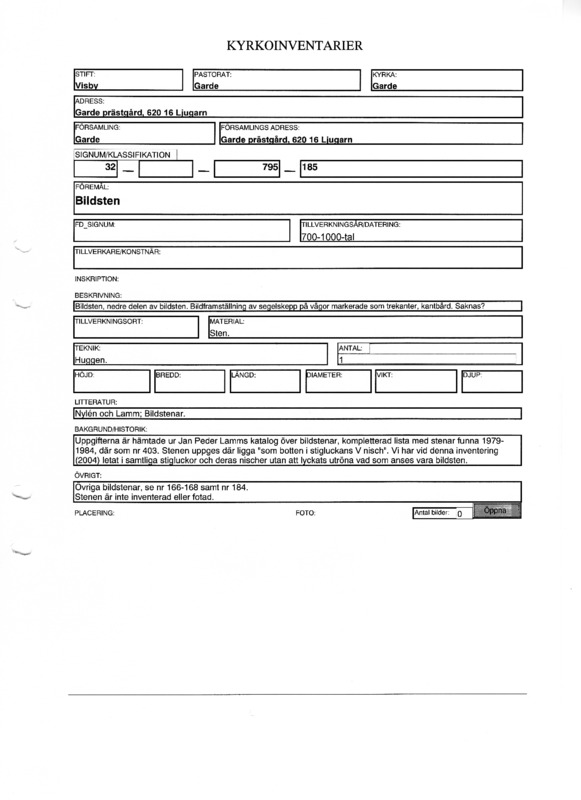
Description of Ornament and Images The figurative depictions remaining on the most northern part of the slab are relatively discernable when applying oblique light. According to Böttger-Niedenzu’s drawing, they represent the outline of the right half of a ship, which is placed above a rudimentary preserved row of three triangles (waves). The stem is short, rising vertically but then turning to the right almost horizontally. An element that rises up next to the stem, which narrows towards the top and overtopping the stem, could be interpreted as a crewman turning to the right (i.e., east). Above the huge crewman and the stem, the lower horizontal frame of the ship’s sail is discernable. The sail itself is lost, except some tiny parts of carved rhombi in the top right (i.e., northeast) corner of the stone. Three sheet ropes are running towards the sail, one behind the possible crewman and two in front of him, apparently fastened to the stem. In front of the ship, a figure in raised relief is discernable but difficult to describe and hardly interpretable (Böttger-Niedenzu 1988, p. 9: “unregelmäßiges, zweilappiges Gebilde” [ʻirregular, bilobed shapeʼ]).
Interpretation of the Imagery No interpretation
Type and Dating The size of the fragment, the carving technique and the ship motif indicate a Type C/D picture stone. Therefore, it can be roughly dated to between the 8th century and the 10th century. The stone provides several remarkable features: Sheet ropes directly attached to the top of the stem are quite unusual. They can also be observed on the Type D stones GP 211 Klinte Hunninge III and GP 94 Garda Bote (both Type D according to Lindqvist). The strange shape of the stem, however, is without comparison. Triangular waves are depicted on a relatively small group of Type C/D stones (in particular, GP 170 Halla kyrka 5, GP 212 Klinte Klintebys, GP 572 Eksta kyrka and GP 563 Väte kyrka 2 as well as GP 280 När Smiss I). Finally, the ship’s position on the stone must be regarded as a particular characteristic. As the sailing ship is not placed in the lower part of the picture stone as usual but rather in its upper body or neck area, the Garda stone is closely related to GP 209 Klinte Hunninge I and the monuments GP 21 Ardre kyrka VIII and GP 5 Alskog Tjängvide I (both Type D according to Lindqvist). A similar position of the ship, also including the triangular waves, can be seen on Klinte Klintebys and Väte kyrka 2. Therefore, the Garda monument could be considered as belonging to Lindqvist’s ʻKlinte-Gruppeʼ or to the ʻTjängvide Gruppeʼ.  GP 211 Klinte Hunninge III
 GP0094
 GP 170 Halla kyrka 5
 GP 212 Klinte Hunninge (IV) (Klintebys)
 GP 572 Eksta kyrka
 GP 563 Väte kyrka 2
 GP 280 När Smiss I
 GP0209
 GP 21 Ardre kyrka VIII
 GP 5 Alskog Tjängvide I
References Böttger-Niedenzu 1988, pp. 8–9, drawing 5.
Bildstenen påträffades 1984 i den västra nischen av den norra stigluckan in till kyrkogården i Garda.
Nuvarande lokalisering
Samma plats som när bildstenen påträffades 1984.
Beskrivning
Tillhugget fragment av en svampformig bildsten (typ C-D) 162 x 38 cm. På fragmentet rester av ett skepp, med segel, rigg och vågor bevarat. På skeppet en besättningsman.
Datering
Dateringen kan inte anges närmare, men bildstenen tillhör perioden 700-900-talen.
Tolkning
Ingen tolkning
AA
TitleGP 95 Garda kyrka 7
RAÄ ID Garde 124
Jan Peder Lamm ID 403
Last modified Apr 21, 2026