GP 577 Anga Änggårda


mer grejer
0.0
| Plane | Position | Flip |

 |
||

 |
||

 |
| Show planes | Show edges |
Parish Find Location Anga
Find Location A meadow south-east of Änggårda in Anga parish.
Find Context Classification Agricultural Field
Present Location Classification Gotlands Museum Magasin Visborg
Coordinate Present Location (lat) 6390259
Coordinate Present Location (long) 695514
Year of Discovery 1922
Material Limestone
Height 82
Width 43
Thickness 10
Lindqvist Type B (ca. 500-700)
Lindqvist Shape Dwarf stone
Iconographic Keywords ship
Runic Inscription or not No
Secondary Inscription or Not Yes
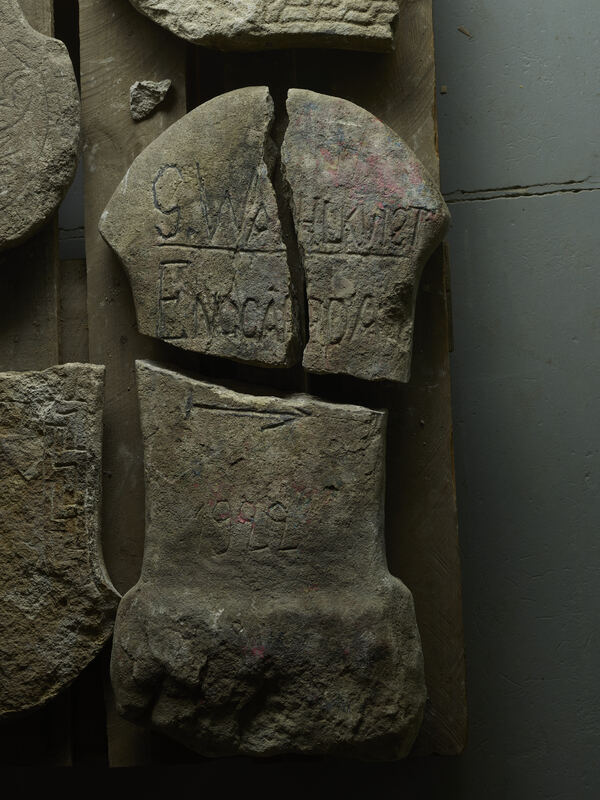
Secondary InscriptionThe inscription was carved by the finder in 1922 on the stoneʼs undecorated backside (face B), filling the entire space of the surface. It is deeply carved and clearly readable. The first line is underlined and between the second and the third line, a rightwards pointing arrow is depicted.
G.WAHLKVIƧT
ENGGÅRDA
1922
Context and Discovery Discovered in 1922 by the farmer Gustaf Wahlkvist during the cultivation of a meadow (löväng) about 300 m south-east of his farmstead, which represented the southernmost part of Änggårda (all information taken from the report ATA dnr 3270-1943). The stone was “lying loosely in the soil”, without any further finds or archaeological context. Wahlkvist re-used it as signpost, carved his and the farmʼs name on the monumentʼs backside (see VIII), and placed it next to (north of) the road which connects Anga church with the road between Kräklingbo and Roma. In 1943, Mårten Stenberger became aware of the picture stone by Wahlkvist informing him about the find circumstances and the fact that the ʻsignpostʼ had recently been smashed in an act of malicious destruction. Stenberger found the stone broken into three large and two small pieces and arranged to have them transferred to Gotlands Museum, where the pieces were put together again.
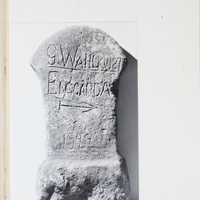
Measurements, Material and Condition Despite its fragmentation, the small picture stone is completely preserved. The fragments were put together in 1943 (see photo taken by Raymond Hejdström, GF neg. nr. XXI:572–573). However, today the monument is broken again, representing three pieces. The picture stone is 82 cm high, its width is 43 cm between the corners of the head and 31 cm just above the massive pedestal-like root. The root itself is 23 cm high and 40 cm wide. The limestone slab is between 5 and 10 cm thick. The right half and in particular the upper field of the stoneʼs front face (face A) are somewhat weathered; its upper right area is partly damaged.
Description of Ornament and Images A decorated border, which represents a geometrized twisted-cord pattern (step pattern), frames the image field (i.e., face A) and divides it into an upper and a lower panel. In the upper panel, on the monumentʼs head, only faint remains of a simple ship with rising stems are discernable, while the lower panel is empty. The stoneʼs backside (i.e., face B) is not carved but features a recent inscription (see VIII).
Interpretation of the Imagery No interpretation
Type and Dating Middle type picture stone, i.e., Type B according to Lindqvist, dating between AD 500 and 700. Following Lindqvistʼs typology, the monument can be described as ʻdwarf stoneʼ with convex, almost semi-circular head and corners protruding horizontally. It corresponds to the stones subsumed by Lindqvist in his Stenstugruppe (1941/42 I, pp. 37–38), which is characterized by the shape as well as depictions of aquatic birds in the lower and a simple vessel (i.e., a ship of the Rikvidetyp – ibid. I, p. 66) in the upper field of the stone. However, Lindqvist does not exclusively assign stones with bird depictions to this group. These monuments are frequently decorated on both sides. Lindqvist considers them to have been placed pairwise on graves. Good parallels are GP 24 Ardre Petsarve II and GP 107 Gothem Västerbjärs.  GP 24 Ardre Petsarve II
 GP 107 Gothem Västerbjärs
References Oehrl 2019a, p. 42, pl. 22b.
Bildstenen påträffades 1922 vid uppodling av ett änge 300 m sydost om gården Änggårda. Upphittaren högg in sitt och gårdens namn på stenens baksida, och satte upp den vid en väg som en vägskylt. Efter att stenen hade slagits sönder i tre delar fördes dessa till Gotlands museum 1943.
Nuvarande lokalisering
Gotlands museums magasin på Visborgsslätt.
Beskrivning
En dvärgsten (period B), 82 cm hög och som bredast 43 cm. Kantdekor, som delar stenen i två bildfält. I det övre bildfältet svaga spår av ett skepp med stävar. I det lägre bildfältet finns inga spår av bilder.
Inskrift
Ingen ursprunglig inskrift, men på baksidan är inhugget:
G.WAHLKVIST
ENGGÅRDA
1922
Datering
Kan inte dateras med säkerhet, men tillhör perioden 500-700.
Tolkning
Ingen tolkning.
AA
TitleGP 577 Anga Änggårda
Fornsök ID L1977:1476
RAÄ ID Anga 207:1
Last modified Apr 24, 2026